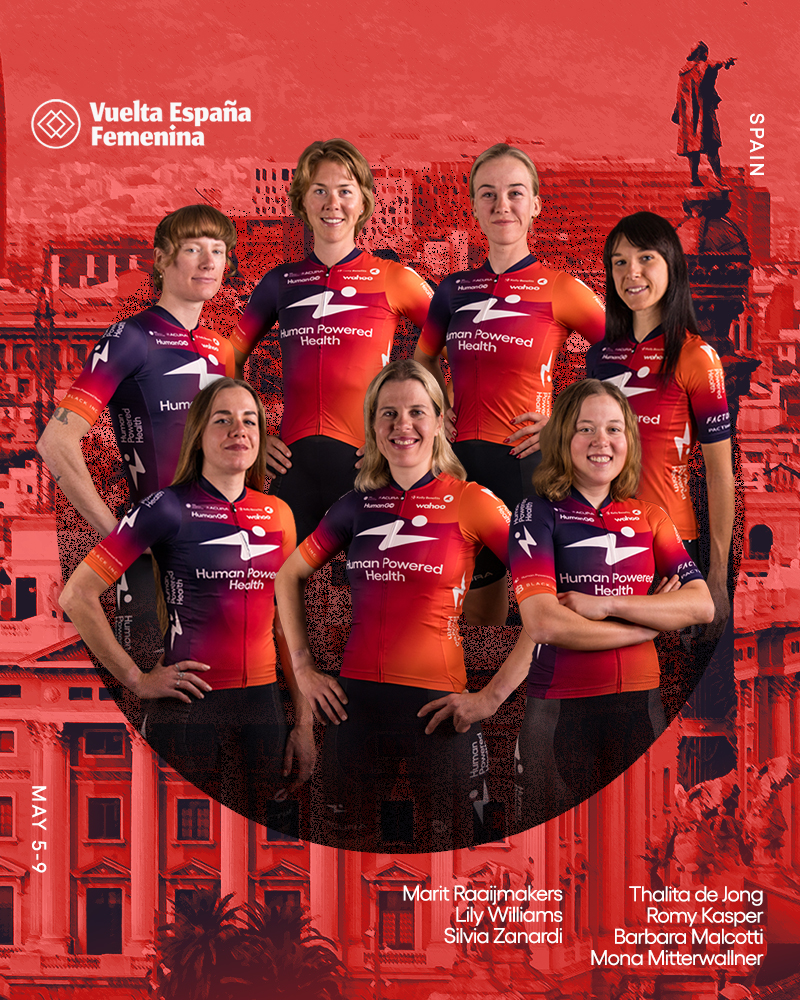
Human Powered Health heads to the first Grand Tour of 2025, La Vuelta España Femenina, bringing its climbing power to Spain from May 4 through 10.
With two high mountain stages punctuated with hilly days and bunch sprints, the opening to stage-race season will be a blockbuster battle.
The roster combines the team’s climbing strength with domestiques and flatland experts for the eclectic parcours. Thalita de Jong returns from injury and leads GC hopes alongside climbers Barbara Malcotti and Mona Mitterwallner. Silvia Zanardi is the protected sprinter for the flat days with Romy Kasper, Marit Raaijmakers, and Lily Williams completing the roster with their considerable all-round abilities, domestique strengths, and qualities for the opening day team time trial in Barcelona.
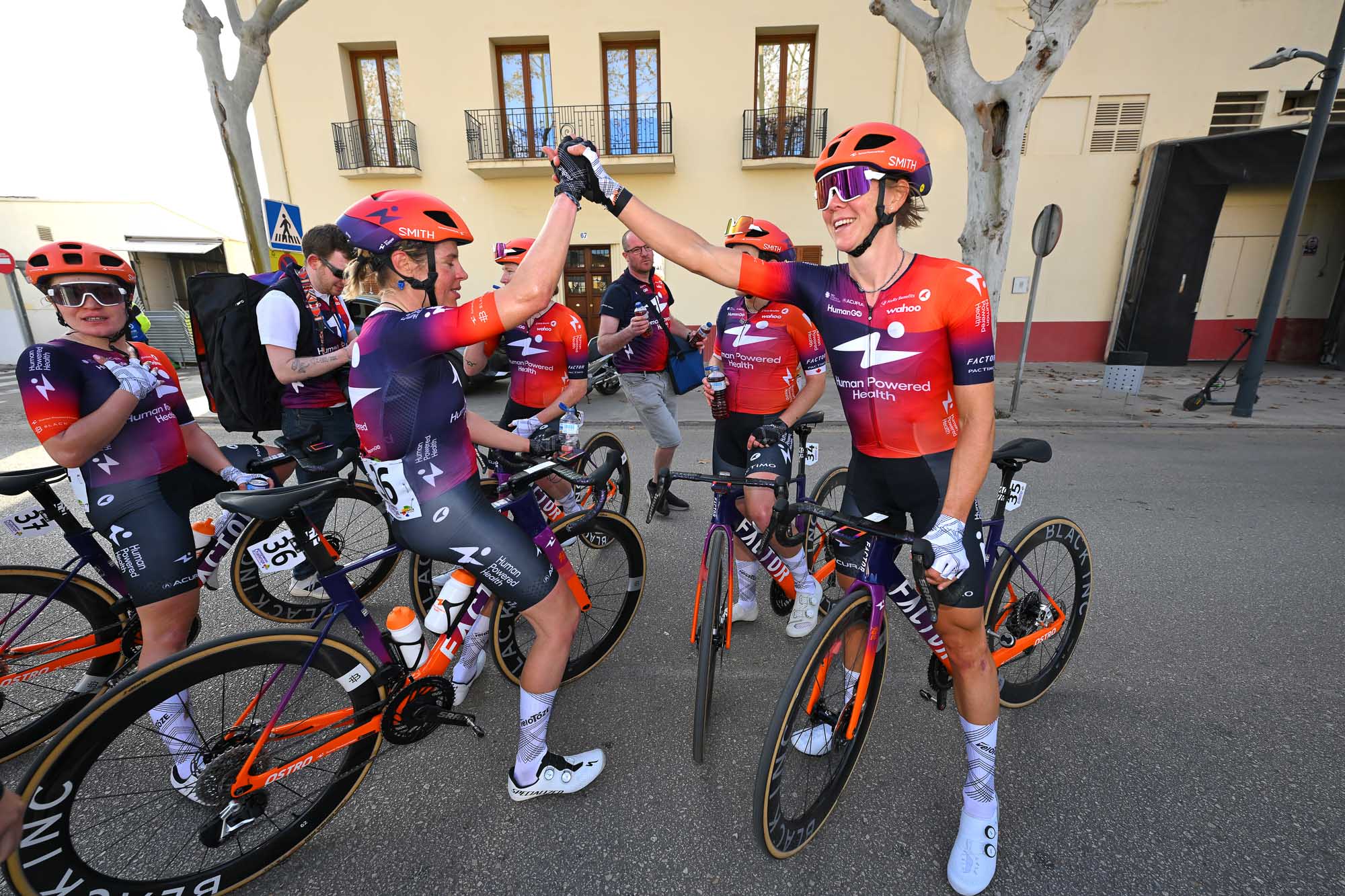
De Jong’s Trofeo Binissalem-Andratx win in January showcased her strengths on the type of terrain that the race passes over. Malcotti will also hope to be on the sort of form that saw her finish the UAE Tour Women sixth overall, with Mitterwallner also coming into her own race-by-race, as displayed by her second-place finish at the Grand Prix Féminin de Chambéry.
Kasper, Raaijmakers, and Williams were instrumental parts of the Classics squad and will call on their combined power to assist Zanardi in the sprints and set the team up for success in the two mountain top finishes that will define this year’s edition.
How to watch
USA and Canada
FloBikes 6/2 – 6/0
UK
TNT Sports/Discovery+
Europe
Eurosport/Discovery+
Belgium and the Netherlands
Max via the B/R Sports Add-On
The team has been in Spain for a week, laying the groundwork for the racing with a particular focus on TTT training. Thalita de Jong is also back and excited for the start of a block of Spanish stage races that – for the team – will include la Vuelta, Itzulia, and Vuelta a Burgos.
“We’re making sure that everything will work on Sunday for the TTT,” de Jong explained. “We’re making progress with every training session, and it’s been helpful being over here ahead of the race. We acclimatised and have a good amount of time for recovery too, which is important.”
The circuit around the streets of Barcelona is short and will suit the abilities against the clock of the likes of de Jong, Kasper, Raaijmakers, Zanardi, and, of course, Olympic team pursuit gold medalist Lily Williams.

“It’s a short TTT, so the speed will be dead high, so there won’t be huge gaps, but it’s important to keep us all together,” says de Jong. “But, it’s not the biggest stage.”
That accolade is reserved for the high mountain top finishes of stages 5 and 7, the queenmakers of this year’s edition.
“For myself, after six weeks away, we will see where I am with my level,” explains de Jong. “But, the feeling is good, I’m training well and having a good recovery after training. I’m in good shape and can see the others are too, so we will see how it goes on those two stages. I will take it day by day.”
Vuelta España Femenina Stage by Stage
5/4 Stage 1 | Barcelona – Barcelona (8.1km) TTT
As it has each year, the Vuelta begins with a team time trial, this time around the beautiful Catalan streets of Barcelona. Taking in the sights of the bustling city, it’s a stunning way to kick off the action and will lay the bedrock for the GC battles to come.

5/5 Stage 2 | Molins de Rei – Sant Boi de Llobregat (99 km) Hilly
After a category 2 climb right at the start, stage 2 meanders through the plains of Catalonia before the expected sprint in Sant Bo de Llobregat. Just shy of 100 km, it’s a gentle beginning to the road stages and is part of a doubleheader of stages that suit the likes of Zanardi.

5/6 Stage 3 | Barbastro – Huesca (132.4 km) Flat
With no categorized climbs and a technical finish in Huesca, we can expect the script of stage 3 to be similar to that of stage 2. However, crosswinds may well whip across the exposed roads, so depending on their strength, we could see splits and echelons in the peloton.

5/7 Stage 4 | Pedrola – Borja (111.6 km) Medium Mountains
If a GC pecking order has emerged, stage 4 could suit breakaway specialists. With two climbs on route, a strong group could survive to battle out for the win in Borja. The category 3 Puerto de El Buste tops out 11 km from the line and could shed the group of pure sprinters, but if it comes back together, expect the strongest finishes to emerge in a reduced group sprint.

5/8 Stage 5 | Golmayo – Lagunas de Neila (120.4 km) Mountain
The first mountain top finish of the race takes the peloton to the steep pitches of Lagunas de Neila. The first proper GC blow will come on the 6.5 km at 8.9% finishing ramp. As the adage goes, you might not win the race here, but you could see your overall hopes go up in smoke.

5/9 Stage 6 | Becerril de Campos – Baltanás (126.7 km) Flat
With just 753 meters of climbing, on paper, stage 6 is the flattest of the race. But that only tells half the story. There’s a succession of three short but steep hills in the last 20 km, but expect the sprinters to deal with this for a bunch finish in Baltanás. The GC teams surely won’t want stage 6 to be a hectic affair ahead of the Vuelta’s mammoth finale the next day?

5/10 Stage 7 | La Robla – Alto de Cotobello (152.6 km) Mountain
The Vuelta concludes with a brutal queen stage up in the mountains. With 2,880 meters of climbing and ascents of the Alto de la Colladona, Alto de la Colladiella, and Alto de Cotobello, it’s sure to be one of the most epic days of racing this season. The GC will likely be poised for the showdown on the 10.5 km at 8% finishing climb.

Follow comprehensive day-to-day coverage of the team across our social media networks.
Photos: GettySport and ASO