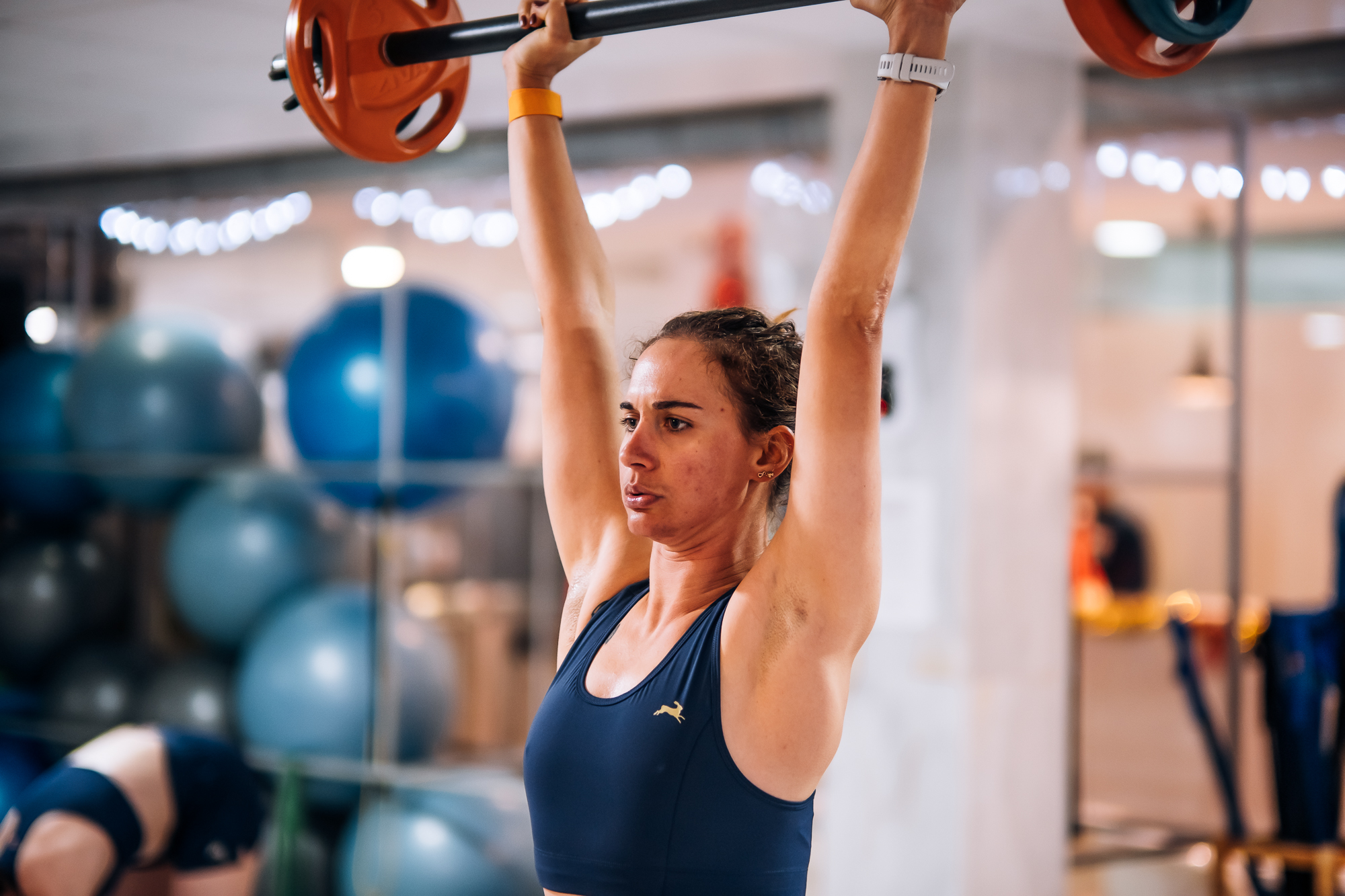
Hard work off the bike has a huge link to performance on the bike. Strength and flexibility training in the gym builds a baseline to help you ride harder, longer and faster.
For Olympian Maggie Coles-Lyster, strength work as a key component of her training.
“Strength in the gym translate to greater power production on the bike, which is especially important in sprints and short bursts of power,” Coles-Lyster explains. It’s also important for injury prevention by addressing muscle imbalances and by building overall body strength and support for muscles and tendons.”
With cycling being a non-weight-bearing sport, lifting and jumping in the gym is also important for maintaining healthy bone density. Team coach Enrico Campolunghi works tirelessly in the gym with our athletes for this reason.
“The repetitive pedalling motion and unnatural posture on a bicycle can cause imbalances in young athletes,” says Campolunghi. “Gym training counteracts this by focusing on developing various forms of strength, enhancing general motor skills, and maintaining balanced kinetic chains.”
These routines build on-bike performance.
“Functional exercises that stabilize posture and build balance help maintain a strong, efficient position on the bike, while strength work targeting limb extension and flexion enhances pedalling effectiveness, says Campolunghi. “Together with metabolic conditioning, these elements shape performance by enabling cyclists to apply force efficiently and with minimal energy waste.”
These 11 gym exercises will help you perform better on the bike.
1. Squats
What it is: A lower-body exercise with a barbell resting on your shoulders. Bending at the hips and knees until you’re in a sitting position, then returning to standing.
Where it builds strength: Quads, glutes, hamstrings and core. Build strength and explosive power.
View this post on Instagram
2. Box Jumps
What it is: Jumping from a squat position on the ground onto a box or platform.
How it builds strength: Fast-twitch muscles, explosive power and bone density.
3. Trap Bar Deadlift
What it is: Using a hexagonal (trap) bar, lifting from the floor with knees bent, hips back, exploding upwards to a standing position.
How it builds strength: Lower body. Builds explosive movement, power output, and posterior chain strength.

4. Split Stance RDL (Romanian Deadlift)
What it is: A hip hinge exercise with one foot in front of the other, using either dumbbells, a barbell or a hexagonal (trap) bar.
How it builds strength: Posterior chain. Addresses lateral imbalances by putting more emphasis and weight on the front foot.
5. Hurdle Hop / Single Leg Hurdle Hop
What it is: Jumping over a series of small hurdles or quick bounces on the spot with two legs or one leg.
How it builds strength: Single-leg stability, quick reaction time, explosive power.
6. Barbell Hip Thrust
What it is: With a barbell across the hips and shoulders on a bench, transition to a glute bridge position and lower back down.
How it builds strength: Glute strength and power. Also good for hamstring and core strength.
7. Back Extension
What it is: An extension with legs and hips resting on a ball, a bench or a back extension machine.
How it builds strength: Spine/back, glutes and hamstrings. Good for lower back injury prevention.
8. Single Leg Explosive Leg Press
What it is: Using a leg press machine, with one leg straight, bending the knee to lower the machine, then pushing hard against it to straighten the leg again.
How it builds strength: Single-leg power and explosiveness.
9. Single Arm Dumbbell Row
What it is: Straightening and bending through the elbow while holding a dumbbell. The other hand supports the elbow by resting on a bench or box.
How it builds strength: Back, arms and shoulders.
10. Bird Dog
What it is: From a tabletop position, extending opposite hand and leg out straight, then “crunching” in so your elbow meets your knee.
How it builds strength: Deep core muscles, glute activation, spinal stabilizers and balance.
11. Cable Twist
What it is: Using a band or cable, rotating the torso and hands to the side.
How it builds strength: Core strength and mobility via resistance of the band or cable during the rotation.

How to schedule
Having a set routine of exercises and dedicating time to them at regular intervals leads to big results on the bike.
“Athletic preparation for cyclists should be continuous and year-round, with training adjusted for competitive and non-competitive periods,” says Campolunghi. “In non-competitive phases, 3 – 4 weekly sessions (60 – 90 minutes) focus on general conditioning, strength development, and mobility. In competition periods, 1– 2 shorter sessions (40–50 minutes) maintain strength, functionality and mobility, ensuring consistent performance without overloading.”Using AI-based coaching from HumanGO can help you stay on the straight and narrow and learn from and then adapt key areas. Start your journey today with a free trial.